

One of the questions I hear most from parents is some version of "Is my child learning to read and write?" It is a completely understandable question, especially with the increasing focus on literacy from the Ministry of Education. But when I think about what literacy really looks like in early childhood, the answer is so much bigger than letters on a page.
Literacy does not begin when a child picks up a pencil or sounds out their first word. It begins in relationships, in sensory experiences, in the natural world, and in play. This is something I feel passionate about, shaped deeply by the work of Pennie Brownlee, whose workshops I attended in 2016 and whose book Magic Places continues to influence how we think about learning at Our Kids. It has also been shaped by years of watching tamariki at our centres, and more recently by spending time with my two-year-old granddaughter, who reminds me every day how learning really works.
The very first literacy is "people literacy." In those early years, from birth to around three, tamariki learn through relationships. Knowing a parent's face and smell. Having their needs met by someone they trust. Learning to listen and communicate. Understanding their own emotions and the responses of others.
This is not just a warm-up before the "real" learning starts. It is the foundation everything else is built on. At our centres, kaiako support this every day. When a toddler says one word, we build on it with two or three. When a child is gathering objects, we provide the language that matches their exploration: heavy, light, smooth, rough. When a child is looking at herself in the mirror, we gently offer vocabulary about facial features. It is always meaningful, always connected to what the child is actually interested in.
I see this with my granddaughter all the time. From when she was very young I have told her stories, real stories from her own life. I tell her about the sheep and the goat pushing through the fence to eat the food, and she laughs and acts out the actions herself. I tell her about the ducks she chased in circles on a walk, and her eyes light up as she relives it. These are her own experiences being retold, and through that retelling she is building oral literacy in the most natural way.
The next stage is "eco literacy," where tamariki learn through interaction with the wider world, particularly nature, usually around ages four to seven.
In Magic Places, Pennie Brownlee explains that children are born with two driving needs: to bond with their primary caregiver, and to explore the world at all cost. That exploration has to be three-dimensional. Touching, smelling, handling, tasting. Scientists have identified over nineteen human senses that work together to deliver rich "packages of perception," building a sensory body of knowledge and billions of neural connections. A screen cannot replicate this. It is "sensorially impoverished."
At one of our centres, a swan plant had grown big and cocoons were appearing everywhere. Tamariki could see the whole life cycle of a butterfly right there in their environment. Because this centre provided paint inside and outside almost every day, children had the means to express what they were experiencing. I watched a toddler painting the life cycle of a butterfly, not because anyone asked them to, but because the experience was there and the resources were there. The art that came from this centre was extraordinary.
Another example: a child at one of our centres looked at a plum and called it a tomato. We supported their curiosity in the moment, and later visited the tomato plants and plum tree together to compare and discover. Eco literacy happening through genuine wondering.
This is where I see a really important link between art and literacy.
When a child has an experience, they unconsciously download a multisensory package: words, feelings, and a value rating of the whole experience. This gets filed in memory and can be called up later. The child relives some or all of it and expresses it through spoken words, dance, song, or art.
When children hit "the big blank" and say "I can't do it," the kaiako's role is not to ask "what does the cat look like?" because that asks the child to access a visual image. Instead, we say "tell me about the cat," and that helps them relive the full sensory experience, which unlocks the expression.
After an extensive period of making marks and patterns, something wonderful happens. Children begin to realise that their marks can represent something. Initially, as they are developing object constancy, a child might paint a circle and tell you "this is Mummy," and a moment later say "it's a sun." The meaning shifts, and that is completely normal. Once object constancy is established, "Mummy" stays "Mummy," but their drawing of Mummy will not look like an adult's drawing, because children at the symbol stage, roughly ages four to ten, are not drawing what things look like. They are drawing what they know. Realism does not come until after age ten.
Those symbols eventually become code: letters, words, numerals. But too many children are pushed into code before they have had enough time expressing their experiences through pictures. Working with visual symbols lays the foundation for reading, writing, and numeracy, and we must resist the temptation to rush.
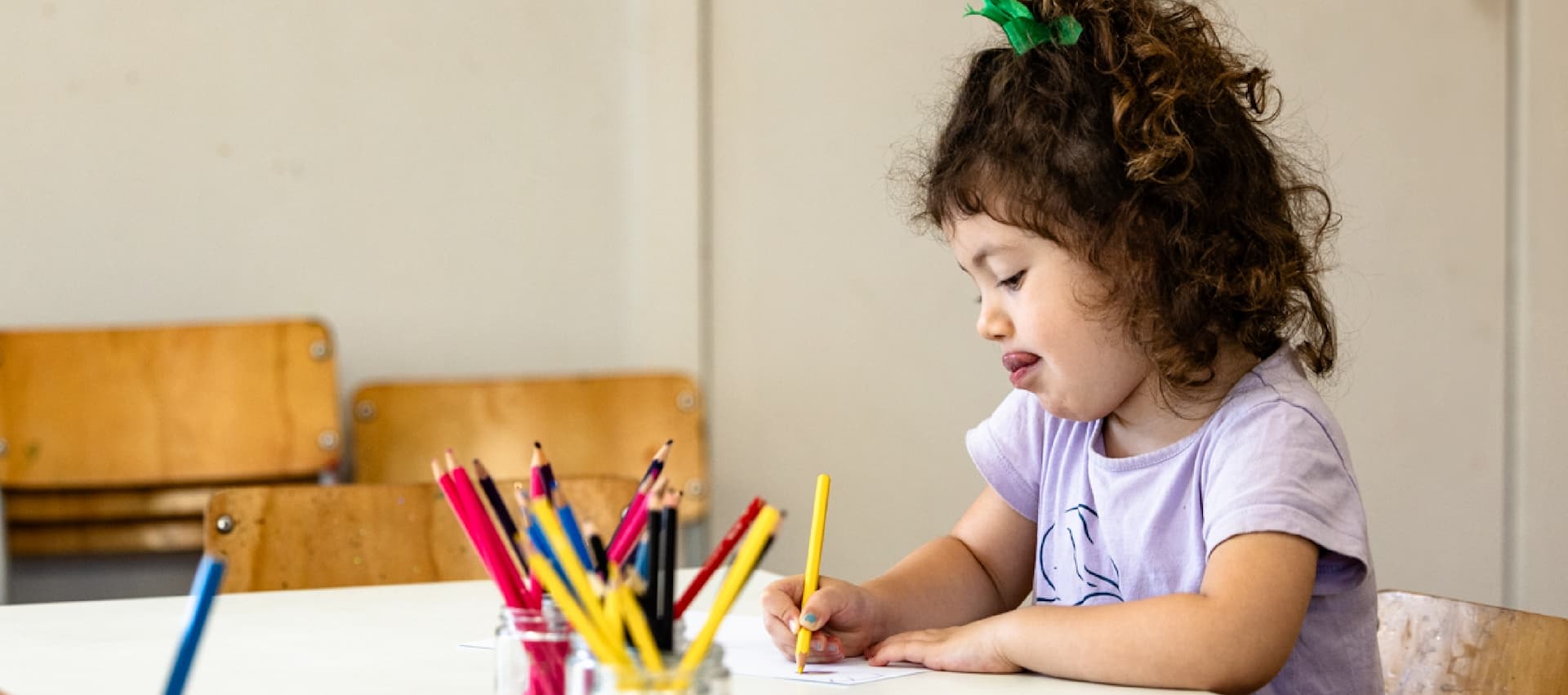
This is why at Our Kids, tamariki have regular access to mark-making materials. Paint most importantly, along with pencils, crayons, pastels, chalks, tabletop chalkboards, and drawing on concrete outside. Activities such as threading beads support fine motor development, and we provide both right and left hand scissors with junk mail or toy catalogues for children who want to cut pictures. At the writing table there are laminated lowercase letters for reference. Kaiako model writing by putting children's names on their artwork, and for those who are ready, support them to write their own names. We follow the child's pace, always.
Books, like screens, are two-dimensional. But that does not mean they are not valuable, far from it. What matters is what the kaiako or parent does with the book.
We have plenty of books available across our centres, and tamariki love repetition of their favourites. But the magic happens when a kaiako makes an impression with a story. One of our teachers, who was incredibly expressive in her storytelling, would read a favourite book several times, then bring in props so children could act it out. With Maui and the Sun, she did exactly this, and afterwards I saw children continuing to play out parts of the story in their own imaginative play. With the Rama and Sita story, the story behind Diwali, tamariki acted out Ravana and Rama fighting, one declaring "this is my Sita." She brought the Three Bears to life by making real porridge. She turned 2D stories into 3D experiences, and the children became the storytellers themselves.
I experienced this with my granddaughter too. She can be strong-willed and sometimes decides she does not want a book before it is even opened. When I introduced 10 in the Bed, I did not start with the book. I put nine soft toys on the couch with her favourite baby doll, said the doll asked everyone to roll over, they all rolled over and one fell out. "Uh oh!" A phrase she loves. The soft toys were not even the same animals as in the book, but it did not matter. The experience came first, and after that she was happy to listen to the actual book and could tell me which animals fell out.
Her Thomas the Tank Engine 100 Words book tells the same story. She loves the pages where the train stops at a farm, a zoo, and a station, all things she has experienced. But the circus page? No interest at all. She has no experience with a circus, so the page means nothing to her yet. Children engage with what they have lived.
Books are also where we model visual literacy: reading from left to right, pointing to illustrations, naming things in pictures. We have looked at birds together from the balcony and wondered what they eat. In her book there is a worm hidden under a flap with a bird pictured above. I once held the flap down and said "bird, don't catch me." Now when we come to that page, she will not let me open the flap. She holds it down and says "hide" because the bird will eat the worm. She has taken what I modelled and made it completely her own, a child becoming a producer, not just a consumer.
At Our Kids, a print-rich environment does not mean a cluttered one. We integrate print authentically: recipe books by the play kitchen and during real cooking, a calendar in the family area as you would at home, matching games and puzzles. Children's artwork, photos of tamariki engaged in play, and learning documentation are displayed with purpose. A calm, homely space where tamariki are not overwhelmed by visual noise means they can actually engage with what is around them.
Technology has a place too. An educational video, songs during mat time, audio listening games, or a laptop used alongside children for research. But it is always purposeful and limited, sitting alongside real experiences rather than replacing them.
Literacy at Our Kids lives in both our planned and emergent curriculum, from baking and festival celebrations to the spontaneous moments when a child's curiosity leads us somewhere unexpected.
We also recognise that phonemic awareness, hearing and playing with the sounds in language, is an important building block. We already integrate this through waiata, stories, and the natural rhythms of language. With older tamariki, we are looking to grow this further through playful games: clapping syllables in children's names, "I spy" using beginning sounds, making a "silly soup" where everything starts with the same sound, or pausing before the rhyming word in a familiar book and letting tamariki fill it in. Always play-based, never formal instruction.
Te reo Māori is a natural part of our literacy environment through books, waiata, and karakia. Songs and stories are also shared in other languages during festivals and throughout the day, depending on the strengths of our kaiako and the interests of our tamariki and whānau. Parents are a wonderful resource here too, sharing their home languages with us.
The part of the brain required for cultural literacy, which involves symbols, stories, and formal written language, usually comes online around age seven. Tamariki are building foundational knowledge before that age, but pushing formal literacy too early can take away from the rich learning that should be happening through relationships, sensory exploration, and play.
At Our Kids, we are laying these foundations every day. The Ministry of Education's Kōwhiti Whakapae framework supports this approach, emphasising that emergent literacy develops best through play-based experiences, phonological awareness, a thoughtful print environment, meaningful stories, and plenty of mark-making, all without undue pressure.
So if you are wondering whether your child is learning to read and write, look at what they are doing. Are they exploring, asking questions, making marks, telling stories, acting out adventures, singing songs, noticing patterns? Then they are right where they need to be. The literacy is already happening.
Reference: Pennie Brownlee, Magic Places (Good Egg Books, 2016).